Beginning the Journey to your First Tune
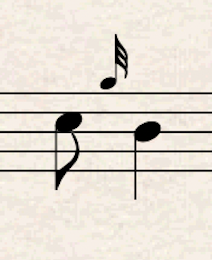
Two gracenote examples from Scots Wha Hae are shown below:
1) Going from one note to the same note with a gracenote.
Play this gracenote short and sharp.
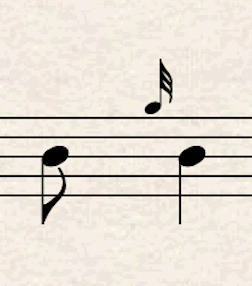
2) Going from one note to a different note with a gracenote.
Continue to play this gracenote following the order of events and slow enough to follow all of the steps.
Recap: Gracenotes- The Next Step
We will continue to work on gracenotes.
We will take two very different approaches to playing gracenotes:
1) Going from one note to the same note with a gracenote.
2) Going from one note to a different note with a gracenote.
Two examples from Scots Wha Hae are shown at the top of the page.
One note to the same note with a gracenote.
One note to a different note with a gracenote.
Remember: There are only two things that happen at any given moment in piping. You are either going from one note to another, or one note to another with a gracenote on it.
A Final Note About Scots Wha Hae
The only thing you will see in Scots Wha Hae that is new, is a tie.(see below)
A tie is a curved line that connects the heads of notes of the same pitch.
You will see two low A notes connected with a tie in bar 8.
This just means that they are two notes of the same pitched played longer.
Nothing for us to be concerned about for the moment.
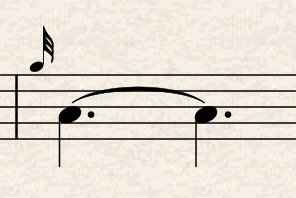
Example of two tied notes in Scots Wha Hae
Gracenote Practice – Key Tips
1. Play Gracenotes Short and Sharp
When practicing gracenotes on the same note (e.g., G,D,E on Low A), focus on quick, aggressive execution.
Avoid just letting your fingers barely lift; instead:
Lift fingers cleanly off the chanter
Make each gracenote audible and distinct
Visual analogy: “Lift your fnger like you’re checking for a tiny bug under it”
Goal: Build strength and clarity in individual gracenotes
2. Gracenotes Between Different Notes
When going from one note to another with a gracenote:
Emphasis is on the order of events (finger off → play note → replace finger)
Accuracy over speed: do not rush
Speed will come naturally after the sequence is mastered
3. Common Mistakes to Avoid
Fingers too tight → gracenote doesn’t fully sound
Playing too fast → extra/unwanted notes appear
Not following order of events → messy transitions
4. Practice Strategy
Same note GDE gracenote: aggressively short and sharp
Different note GDE gracenotes: slow, careful, maintain order
Build clean, strong, controlled technique first, then gradually increase speed
Lesson 14: First Tune Advanced
Gracenote Practice – Timestamped Tips
0:00 – 0:20 | Short and Sharp v (Same Note)
Focus on playing gracenotes really short and sharp on the same note (e.g., GDE on Low A).
Be aggressive with your fingers, making sure they clear the chanter.
Analogy: lift your finger like “checking for a bug under it.”
0:21 – 0:47 | Clarity of Individual Gracenotes
Ensure each gracenote is audible.
Avoid fingers staying too tight → gracenote may not sound.
Goal: build strength and clarity in each gracenote.
0:48 – 1:00 | Gracenotes Between Different Notes
When moving from one note to another with a gracenote, the order of events is crucial:
Lift gracenote finger
Play the next note
Replace the gracenote finger
Accuracy is more important than speed at this stage.
1:01 – 1:24 | Speed Comes Later
Once the sequence is mastered, speed can be gradually increased.
Focus on clean execution first, especially when going from one note to another.
1:25 – 1:53 | Practice Strategy Summary
Same note drills: short, sharp, aggressive gracenotes.
Different note drills: follow order of events, play slowly, then speed up later.
Avoid rushing; incorrect order produces extra/unwanted notes.
2:01 – 2:28 | Key Takeaway
Build control and consistency first.
Gradual speed increase comes after technique is solid.
Always prioritize clarity, order, and finger precision over rapid playing.
Checklist:
Am I in control of my fingers and not going too fast?
Am I following the “Order of Events”
Am I listening for “Runs”
Am I usingthe ‘off first/on second’ technique?
Is my D finger the highest when playing D? Even after the D throw?
Looking down, make sure both knuckles on your index fingers are up.
Are the fingers on both hands straight?
Is my pinky up when the E finger is up and down when the E finger is down?